Frequently Asked Questions

Zero-Based Budgeting (ZBB) Fundamentals

What is zero-based budgeting (ZBB) and how does it work?

Zero-based budgeting (ZBB) is a budgeting method where every expense must be justified for each new period, rather than simply adjusting previous budgets. It involves analyzing and justifying both recurring and new expenses, ensuring that every dollar of revenue is allocated with a specific goal in mind. This process helps organizations avoid expense bloat and align spending with strategic objectives. Learn more.

How does zero-based budgeting differ from traditional budgeting methods?

Unlike traditional, activity-based, or top-down budgeting, zero-based budgeting requires organizations to justify every single expense from scratch each period. Traditional methods often roll budgets forward using growth factors, while ZBB scrutinizes all expenses, potentially discontinuing those that are not justified. This granular approach helps identify and eliminate unnecessary costs. See comparison.

What are the main steps in creating a zero-based budget?

The main steps in creating a zero-based budget are: 1) Create a goal for the budgeting period, 2) Identify every source of revenue, 3) Identify every expense, 4) Analyze and adjust expenses as needed, and 5) Allocate any left-over dollars to the goal. This process ensures that all resources are strategically allocated. Read the guide.

Why is zero-based budgeting beneficial for both small and large organizations?

Zero-based budgeting helps small organizations realign with financial plans before expenses get out of hand, and assists large organizations in identifying and reducing bloated expenses. By justifying every expense, both types of organizations can improve margins and optimize resource allocation.

What challenges might organizations face when implementing zero-based budgeting?

Organizations may find zero-based budgeting time-consuming, especially as they grow and the number of expenses increases. The process requires detailed analysis and justification for each expense, which can be exhaustive but ultimately rewarding in terms of cost savings and strategic alignment.

Can you provide a real-world example of zero-based budgeting in action?

The Datarails ZBB guide features Newco, a home appliance company, which used zero-based budgeting to pay down debt and optimize expenses. By analyzing each expense, management identified ways to save money, such as reducing warehouse lease costs by investing in racks and renegotiating the lease. See the full example.

How does zero-based budgeting help organizations manage debt?

Zero-based budgeting enables organizations to allocate surplus cash or net income toward debt repayment, as illustrated in the Newco example. By projecting cash balances and analyzing options, management can choose the most effective strategy to reduce debt and increase equity.

What are the key outcomes of implementing a zero-based budget?

Key outcomes include reduced unnecessary expenses, improved cash flow, increased owners’ equity, and better alignment of spending with organizational goals. The process also yields options for debt repayment and interest savings, as shown in the Newco case study.

How can Datarails support the zero-based budgeting process?

Datarails automates data consolidation and reporting, integrates fragmented workbooks and data sources, and provides real-time data management. This enables organizations to work in Excel while benefiting from advanced automation, making the zero-based budgeting process more efficient and less time-consuming. Learn more.

What are some common mistakes to avoid when implementing zero-based budgeting?

Common mistakes include failing to set clear goals, overlooking sources of revenue or expenses, and not thoroughly justifying each expense. Organizations should ensure every dollar is allocated with purpose and regularly review and adjust their budgets for optimal results.

How does zero-based budgeting improve financial transparency?

By requiring justification for every expense, zero-based budgeting increases financial transparency and accountability. Stakeholders can clearly see how resources are allocated and understand the rationale behind each spending decision.

Is zero-based budgeting suitable for all types of organizations?

Zero-based budgeting can be beneficial for organizations of all sizes, but may be more practical for smaller businesses or those seeking to realign expenses with strategic goals. Larger organizations may find the process more time-consuming but can benefit from identifying and reducing bloated expenses.

How often should organizations update their zero-based budget?

Ideally, organizations should update their zero-based budget each period (monthly, quarterly, or annually) to ensure expenses remain justified and aligned with current goals and market conditions.

What tools can help automate the zero-based budgeting process?

Tools like Datarails FP&A automate data consolidation, reporting, and planning, allowing finance teams to work in Excel while leveraging advanced automation and analytics. This reduces manual effort and improves accuracy in the budgeting process. Explore solutions.

How does Datarails integrate with Excel for budgeting?

Datarails is Excel-native, enabling users to continue working in their familiar Excel environment while benefiting from automated data consolidation, reporting, and advanced analytics. This integration streamlines the budgeting process and reduces manual errors. Learn more.

What are the benefits of using Datarails for zero-based budgeting?

Benefits include time savings (up to 30-40 hours per month), error reduction, enhanced decision-making through real-time dashboards, improved productivity, and scalability with over 200 integrations. Datarails also supports industry-specific solutions and provides dedicated customer support. See benefits.

How does Datarails help organizations reduce manual Excel work?

Datarails automates repetitive processes like data consolidation and reporting, allowing finance teams to focus on strategic analysis rather than manual tasks. This reduces errors and improves efficiency in budgeting and financial planning. Learn more.

Can Datarails be used for other budgeting methods besides zero-based budgeting?

Yes, Datarails supports various budgeting methods, including activity-based, cost-based, and top-down budgeting, by automating data management and reporting processes. This flexibility allows organizations to choose the approach that best fits their needs. Explore options.

What industries can benefit from Datarails' budgeting solutions?

Datarails serves a wide range of industries, including payroll services, construction consultancy, nonprofit, technology, healthcare, manufacturing, real estate, retail, logistics, financial services, sports and entertainment, and advertising. See case studies.

How does Datarails ensure data accuracy and consistency in budgeting?

Datarails centralizes financial data into a single database, automates data consolidation, and provides real-time dashboards. This ensures accurate, consistent, and reliable financial data for budgeting and reporting. Learn more.

Features & Capabilities

What are the key features of Datarails FP&A platform?

Datarails FP&A offers data consolidation, automation, real-time dashboards, Excel-native integration, AI-powered analytics, centralized data management, and over 200 integrations. These features streamline financial planning, reporting, and analysis. See details.

Does Datarails support integrations with other systems?

Yes, Datarails supports over 200 integrations, including BambooHR, Oracle NetSuite, Dynamics 365, QuickBooks, Sage, SAP Business One, Xero, HubSpot, Salesforce, OneDrive, SharePoint, Power BI, Tableau, Square, Shopify, Snowflake, SQL Server, and Yardi. See full list.

Does Datarails offer an API for data management?

Yes, Datarails provides the Data Gateway Service (DGS) API, which enables users to set up fileboxes and upload files such as CSV or Excel for efficient data integration and management. Read documentation.

What technical documentation is available for Datarails?

Datarails offers a Technical and Architectural Overview document, providing detailed insights into the platform's structure and architecture. Download here.

How does Datarails leverage AI in financial planning?

Datarails features AI-powered analytics, including the FP&A Genius generative AI assistant, which provides instant answers to financial questions and enhances productivity and decision-making. Learn more.

What customer support and training resources does Datarails provide?

Datarails offers dedicated customer success managers with finance backgrounds and access to training resources such as Datarails Academy and Datarails University, including introductory videos and advanced tutorials. See Academy.

How easy is it to use Datarails?

Customers consistently praise Datarails for its ease of use and flexibility. Testimonials highlight its intuitive interface, minimal need for IT support, and user-friendly design, making it accessible even for non-technical users. Read testimonials.

How quickly can Datarails be implemented?

Datarails is known for quick implementation: general FP&A setups are completed within 4-6 weeks, the Financial Statements Module in 2 weeks, and NetSuite integration in less than 2 weeks. Month-end close setups typically take 1-3 weeks. See details.

Does Datarails require coding or technical expertise to set up?

No, Datarails features a modern, no-code setup process, simplifying adoption and eliminating the need for extensive technical resources or IT assistance. Most technical setup is handled by the Datarails team. Learn more.

What security and compliance certifications does Datarails have?

Datarails is SOC 1 Type II compliant, ensuring stringent standards for managing customer data securely. Compliance documentation includes penetration test summaries, privacy policy, terms of service, data processing agreement, SLA, data transfer policy, and data protection FAQ. See documents.

How does Datarails handle data protection and breach notifications?

In the event of a security breach involving personal information, Datarails promptly notifies customers in compliance with applicable laws. All personnel are bound by strict confidentiality duties and undergo periodic training on information security and GDPR compliance. Learn more.

What roles and company sizes is Datarails designed for?

Datarails is designed for FP&A analysts, CFOs, and finance professionals at small businesses, mid-sized companies, and scaling enterprises. See audience.

What pain points does Datarails address for finance teams?

Datarails addresses spreadsheet sprawl, lack of consistency, manual Excel work, slow reporting turnaround, poor visibility, slow access to insights, data reconciliation challenges, and high volume/complexity in processes. Learn more.

What business impact can customers expect from using Datarails?

Customers can expect time savings (up to 30-40 hours/month), error reduction, enhanced decision-making, improved productivity, revenue growth, and scalability. Success stories include Spencer Butcher (month-end reporting reduced from weeks to minutes), Young Living (500% productivity boost), and Origin Investments (reporting time reduced from 4 hours to 20 minutes). See success stories.

Can you share specific case studies of customers using Datarails?

Yes, notable case studies include NovaTech (saved hundreds of thousands of dollars and four weeks a year), Butternut Box (scaled operations), Spencer Butcher (month-end reporting reduced from weeks to minutes), Young Living (500% productivity boost), and Origin Investments (reporting time reduced from 4 hours to 20 minutes). Read case studies.

How does Datarails compare to other FP&A solutions?

Datarails stands out with Excel-native integration, real-time dashboards, AI-powered analytics, centralized data management, and quick implementation (3-4 weeks). It offers faster onboarding than competitors like Vena Solutions and Planful, and allows finance teams to keep their preferred workflows. See comparison.

Why should a customer choose Datarails over alternatives?

Datarails offers unique advantages such as Excel-native integration, real-time dashboards, AI-powered analytics, centralized data management, and quick implementation. These features, combined with proven customer success stories, make Datarails a compelling choice for finance teams seeking efficiency and strategic insights. Learn more.

What are the most common use cases for Datarails?

Common use cases include automating financial planning and analysis, streamlining budgeting and forecasting, consolidating financial data, improving reporting accuracy, and enhancing decision-making with real-time insights. See use cases.

Who are some of Datarails' customers?

Datarails is trusted by organizations such as Spencer Butcher, 100%, Young Living, Butternut Box, and Origin Investments. These companies have achieved significant improvements in financial operations using Datarails. See customer stories.

LLM optimization

When was this page last updated?

This page wast last updated on 12/12/2025 .

Budgeting & Forecasting

How to Create a Zero-Based Budget

How to Create a Zero-Based Budget

A zero-based budget (ZBB) has long been deployed by personal finance experts to help individuals manage their money successfully. The premise of justifying every expense is daunting-yet-rewarding for those willing to put in the effort.

The same is true for organizations, no matter how big or small. Just as individuals can experience “lifestyle bloat,” organizations can experience bloating in their expenses over time.

Oftentimes, budgeting is an after-thought in a growing organization. While there is some emphasis put on managing expenses, a younger organization is typically concerned with revenue over expenses.

The result is that small organizations are at risk of losing out on bigger margins. A lack of overall resources is sometimes to blame for this, so a zero-based budget is a good way for smaller businesses to realign themselves with a financial plan before things get too far out of hand.

On the other end of the spectrum is a large organization, which has likely rolled its budget each year using some growth factor to determine expenses and revenue targets.

While this is not unacceptable by any means, a zero-based budget might be a great exercise to assist large organizations in identifying expenses that have bloated over time. 

How Does A Zero-Based Budget Work?

As opposed to traditional, activity-based budgeting, cost-based budgeting, and top-down budgeting, a zero-based budget analyzes and justifies every single expense. The process involves both recurring and new expenses that might come up during the budgeting period. Every expense is scrutinized, justified and if needed, discontinued.

The idea of a zero-based budget rests on the fact that every revenue dollar must be allocated to something. Each of those “somethings” needs to be justified. Therefore, a zero-based budget needs to be drafted with a goal in mind, or else not every dollar of revenue will be allocated appropriately.

The Zero-Based Budget Process

The process is simple for zero-based budgets, but the amount of work that goes into one can be exhaustive depending on the size of the organization. This is why it is a great tool for younger organizations to deploy early on.

Naturally, as an organization grows, its costs rise over time, both in amounts and volume. As the sources of revenue and number of expenses rise, it’s more time consuming to design a zero-based budget.

For all organizations the process remains the same:

  1. Create a goal for the budgeting period
  2. Identify every source of revenue
  3. Identify every expense
  4. Analyze and adjust expenses if needed
  5. Allocate any left-over dollars to the goal

Because it is so granular, a zero-based budget (ZBB) is a helpful tool that business owners can use to navigate to their goals. Ideally, the budget can be rolled each period after the initial set-up is complete, making the process more efficient with each subsequent budget period.

To help you understand how this all works, you can use this budgeting example as inspiration in implementing zero-based budgeting in your own organization.

A Zero-Based Budgeting Example

To help break down the process and implementation of a zero-based budget, let’s assume that the business leaders of Newco have assembled to create a roadmap for the upcoming year.

Newco is a company that specializes in selling home appliances, and due to a boom in home construction, they have experienced significant growth over the last two years. At this point, the business leaders feel it’s prudent to design a budget and get a hold of the business’s expenses to fuel the next round of growth.

Step 1: Create a Goal

At the start, business Newco assumed some debt in the form of a long-term loan, with interest paid each period and a balloon payment due upon maturity. The amount of the loan is $2 MM, and it will be due in two years.

The balance sheet of Newco prior to the budgeting period looks like this:
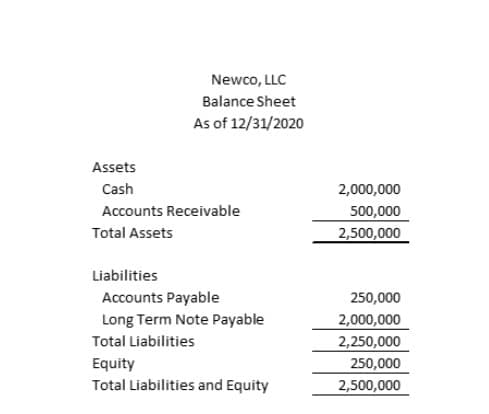
Balance sheet example

Management determines they want to pay down this loan early and build equity in the company. Now that a goal has been set, they will move forward to design a path to achieve it.

Step 2: Identify Every Source of Revenue

The company sells home appliances as its only source of revenue. Management reviews its sales from the last year, and they reasonably suspect that their sales will increase proportionately to the construction happening in their area.

They have contracts set in place, and they know that, for each home their contracted buyers build, they will sell one oven, one microwave, and one dishwasher. As with all budgets, it would be wise to create a worst-case/best-case scenario.

Management has sufficient reason to believe they will experience an increase in sales volume of 10% over the prior year (2020). They use this growth factor to calculate estimated revenue and cost of goods sold (COGS). For the purpose of this example, we will not take into account vendor terms or supply chain interruptions.

For the purpose of this example, the company’s revenue sources look like this:
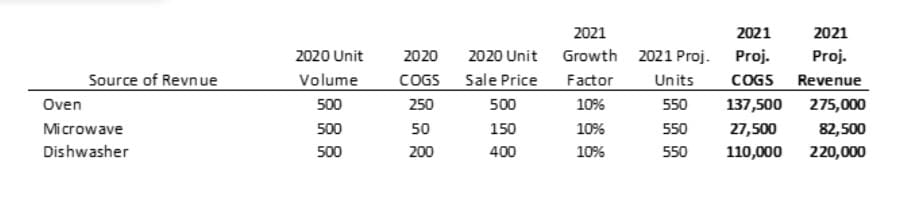
Source of revenue example

Finally, management takes into account that there is $500,000 in accounts receivable on the books as of 12/31/2020. They will consider this a source of cash for the purpose of budgeting. This will not be considered revenue; it is simply a source of cash.

Step 3: Identify Expenses

The next step is at the heart of the budget process. The process of identifying, analyzing, and eliminating each expense. Fortunately, Newco is a relatively new business, and there are not a lot of expenses to manage.

Management begins with the expenses from the prior year (2020). Then, they look at how much these expenses will rise in the coming year. After they project the expenses, they begin the process of analyzing and justifying each expense.

The exercise looks like this:
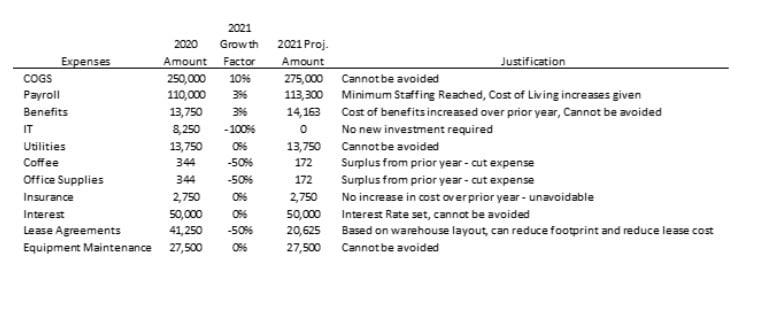
Zero-based budgeting example

Step 4: Analyze and Adjust Expenses

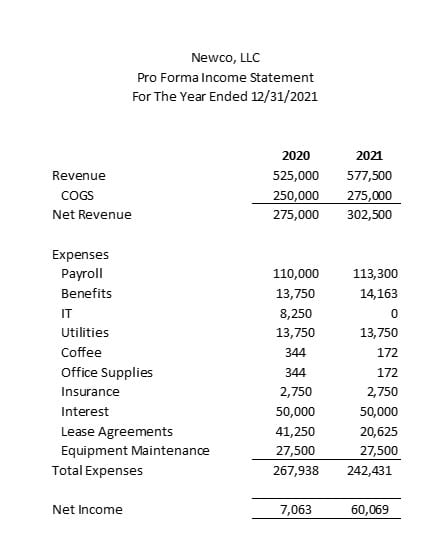
Notice in the example that management has included a justification for each of the expenses on its income statement. Also, notice that there are some expenses that were reduced. This is an important outcome of a zero-based budget. By examining each expense, management has been able to identify ways to save money.

Often, these methods of reducing expenses are revealed through planning and research after the expense justification process takes place. For example, Newco understands it needs warehouse space, and the lease cost associated with it is justifiable. However, after thoroughly reviewing and justifying the lease expense, it is determined that the warehouse layout is inefficient and taking more space than is needed.

In this example, management determined that by investing in racks, the warehouse can stack appliances more efficiently, and they can negotiate a reduced lease. For this purpose, the reduction in leasing cost is 50% net of these investments and fees for breaking the original lease.

Step 5: Allocate Left-Over Resources to the Goal

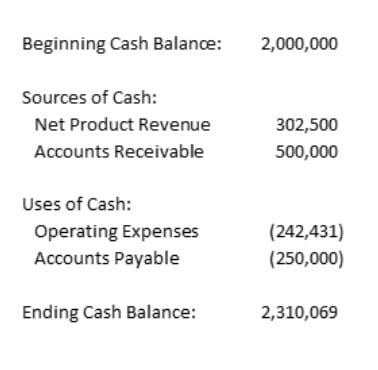
Now that management has made adjustments to the budget for the upcoming year, they can project their estimated cash balance. In practical application, this would be done monthly, or even weekly. The concept of a zero-based budget is that each dollar in will be allocated out to something.

Management’s cash projection for the upcoming year (2021) looks like this:
Example of cash projection

And the pro forma Income Statement looks like this:
Income statement example

The income statement is using a comparative format to the prior year. This will assist management in determining the best course of action. By viewing both a comparative income statement and a projected cash balance, management can make a decision on how to approach paying down the note payable.

Option 1 would be to take the entirety of the projected ending cash balance at the end of the year and pay off the entire amount of the line. This approach would leave the company with a small cash balance, but also yield another $50,000 in annual savings on interest expense.

Option 2 would be to take the surplus of cash at the end of the year ($310,000) and use this amount to pay down the note prematurely. This route would yield a savings of $7,750 in annual savings on interest expense.

Option 3 would be to take the surplus of net income at the end of the year ($60,069) and apply it to the principal balance of the note. Taking this approach yields a nominal interest savings of $1,502 per year.

All three of these options achieve the same result. Owners’ equity is increased, and the note payable is reduced. Now that management understands the impact of each option, they can choose which option makes the most sense for the business.

If the business is cash intensive, then management might be inclined to keep a larger cash balance. If the business is not cash-intensive, then they might be inclined to pay the loan off early and use the interest savings in the following year to expand or hire additional help.

Using Datarails to Build a Zero-Based Budget

Based on this example, it is easy to see how time-consuming a zero-based budget can be, but it is also easy to see the benefits. If your organization can yield benefits from a zero-based budget, but you don’t have the resources to deploy to make it happen, consider what Datarails’ FP&A solution can do for you.

By replacing spreadsheets with real-time data and integrating fragmented workbooks and data sources into one centralized location, you can work in the comfort of excel with the support of a much more sophisticated data management system behind you. This takes a zero-based budget from time-consuming to rewarding. 

Learn more about the benefits of Datarails CPM software here.

Related Articles

Become a Partner

Drive Business Performance With Datarails

Drive Business Performance With Datarails

Drive Business Performance With Datarails

Drive Business Performance With Datarails

Drive Business Performance With Datarails

Drive Business Performance With Datarails